
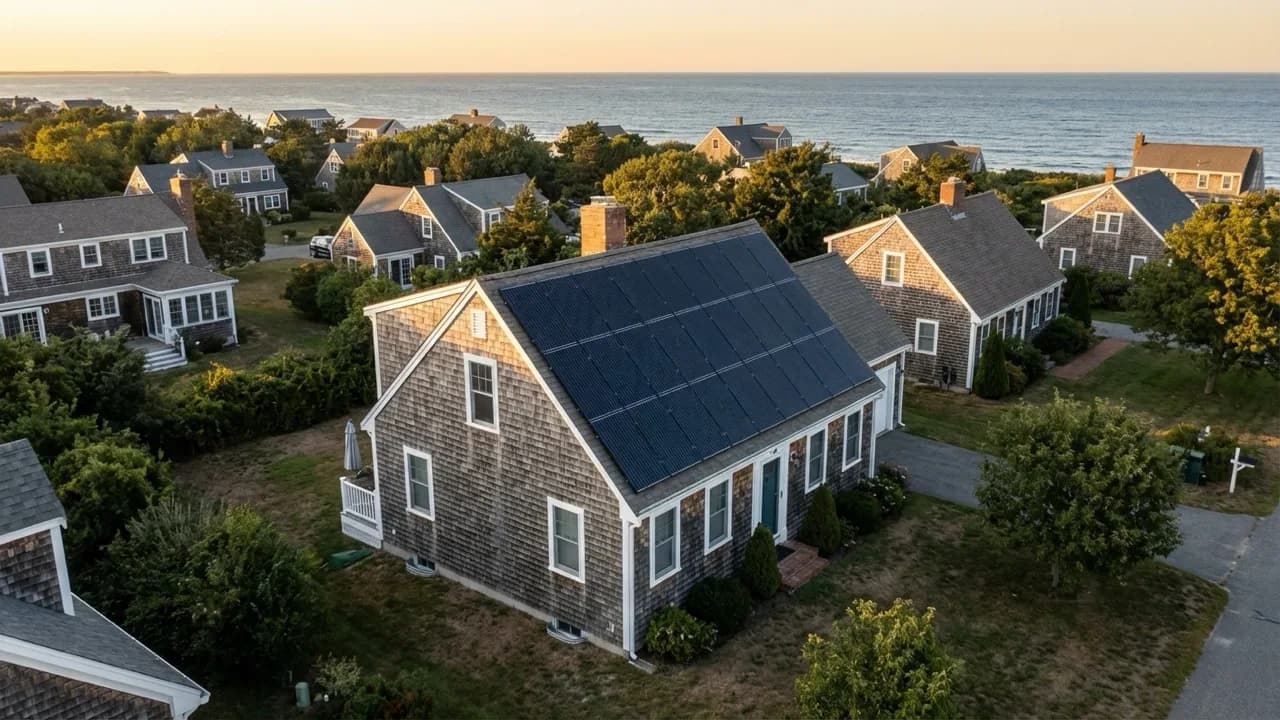
Roof + Solar Bundle in Massachusetts:
Companies, Incentives & Savings (2026)
Massachusetts is one of the best states in the country for rooftop solar — and one of the most financially compelling for a combined roof + solar bundle. The SMART 3.0 program, state tax credits, property tax exemptions, and strong net metering rules combine to make Massachusetts solar economics hard to ignore. This guide covers everything you need to know: which companies serve the state, how the incentives work, what permits you need, and how much you can realistically save.
Why Massachusetts Is a Solar Leader
Massachusetts has consistently ranked among the top 10 solar states in the U.S. — impressive for a small state with four true seasons and its share of nor'easters. The reason isn't geography; it's policy. Massachusetts has built one of the most supportive solar policy environments in the country, with layered incentives that can dramatically improve the financial math for homeowners considering a roof + solar bundle.
The average Massachusetts homeowner pays around $0.24 per kilowatt-hour for electricity — among the highest rates in New England and well above the national average of roughly $0.16/kWh. Those high electricity costs are the single biggest driver of solar ROI. Every kilowatt-hour your panels produce is a kilowatt-hour you don't buy from Eversource or National Grid at premium rates.
For homeowners with aging roofs — and given Massachusetts' housing stock age, many have roofs approaching 20–30 years old — a roof + solar bundle is often the financially optimal approach. Combining the two projects eliminates redundant labor, avoids the costly scenario of removing and reinstalling solar panels when your roof eventually fails, and often allows the entire project to be structured with zero out-of-pocket cost through lease or PPA financing.
Massachusetts has 11 roof + solar bundle providers we track and review. Quality varies significantly — from the region's leading integrated bundle specialist to out-of-state contractors with limited local expertise. Our rankings below are based on our 5-category methodology applied consistently to all companies.
Top Roof + Solar Companies in Massachusetts
Ranked by overall score using our 5-category methodology. All companies below have been verified as operating in Massachusetts.
Evergreen Solar
Editor's ChoicePioneered the "Roof + Solar Bundle" in New England — premium CertainTeed roofing via ShingleMaster PREMIER-certified Global Roofing, paired with a complete solar system in one streamlined project
Sunfinity Power & Roofing
Integrated roof + solar bundle with optional battery storage and mini splits — end-to-end project management by a single in-house team
Golden Group Roofing
Solar from a roofer's perspective — GAF Master Elite certified contractor with in-house solar team, no subcontractors, and a 50-year Golden Pledge roofing warranty
Sunergy Solutions
Solar + roofing + gutters across 7 states — broadest coverage of any company reviewed, with 146 five-star SolarReviews and Enphase Platinum Installer status
Trinity Solar
Solar installation + roofing services — "go solar, replace a roof, or do both" — from the largest privately-owned residential solar installer in the US
New England Energy Experts
Solar + roof as "one seamless installation" — bilingual service with strong Spanish-language outreach
Evergreen Solar Corporation
Evergreen Solar is our Editor's Choice for Massachusetts homeowners. They pioneered the roof + solar bundle concept in New England, use American-made panels with a 25-year warranty, and offer premium CertainTeed Landmark shingles backed by a 50-year manufacturer warranty. Their 4.9★ Google rating across 300+ reviews speaks to consistent, high-quality execution — rare in a space where roofing and solar each carry their own complexity.
For Massachusetts homeowners in the SMART 3.0 program area, Evergreen's expertise with incentive enrollment and utility interconnection makes the difference. They handle everything from permits to SMART enrollment — you don't need to figure out the bureaucratic paperwork yourself.
Massachusetts Solar Incentives (2026)
Massachusetts has one of the most comprehensive solar incentive stacks in the country. A Massachusetts homeowner can layer multiple programs to dramatically improve the economics of a roof + solar bundle. Here's what's available in 2026.
SMART 3.0 Program
Production-Based20-Year TermProduction-based incentive — rate varies by capacity tier and utility
Massachusetts SMART 3.0 (Solar Massachusetts Renewable Target) launched in 2025 as the successor to SMART 2.0. It provides a guaranteed production-based incentive paid per kilowatt-hour of solar energy produced over a 20-year term. The rate varies depending on system size (residential systems under 25kW typically receive higher base rates), your utility (National Grid vs. Eversource), and when you enroll — earlier enrollment locks in higher rates as program capacity fills.
For lease and PPA customers, SMART payments flow to your solar company and are reflected in lower monthly payments. For outright purchasers, SMART payments come directly to you. This is often the single most impactful incentive for Massachusetts solar economics.
Source: mass.gov/smart-program · Last verified: February 2026
Massachusetts Renewable Energy Tax Credit
Purchase Only15% of net system cost, capped at $1,000
Massachusetts homeowners who purchase (not lease) a solar energy system can claim a state income tax credit equal to 15% of the total system cost, up to a maximum of $1,000. This is a non-refundable credit — it reduces your state tax liability but won't result in a refund if it exceeds what you owe. The credit can be carried forward up to 3 years.
Source: mass.gov/renewable-energy-tax-credit · Last verified: February 2026
Property Tax Exemption
20 YearsAutomatic20-year exemption on solar-added property value
Under Massachusetts General Laws Ch. 59 §5, a solar installation won't increase your property tax bill for 20 years — even though it increases your home's market value. For a typical Massachusetts home, a solar installation adds $15,000–$25,000 in assessed value, so this exemption can save $300–$700+ per year in property taxes. In most municipalities, the exemption is automatic — no application required.
Source: MGL Ch. 59 §5 · Last verified: February 2026
Net Metering
Full Retail RateRolls Over MonthlyFull retail rate credit for excess generation sent to the grid
Massachusetts net metering is among the most homeowner-friendly in New England. You receive a credit at the full retail electricity rate (currently ~$0.24/kWh) for every kilowatt-hour your system sends back to the grid. Credits roll over month to month, meaning summer surplus offsets winter bills. Residential systems up to 60kW qualify.
Source: mass.gov/net-metering · Last verified: February 2026
Federal ITC Update: Important Change for 2026
The homeowner-claimed federal solar Investment Tax Credit (ITC) was restructured by the "Big Beautiful Bill" (enacted July 4, 2025). As of 2026, direct homeowner purchase tax credits have ended. However, solar leases and PPAs (Power Purchase Agreements) continue to benefit from a 30% ITC through 2027 under Third-Party Ownership rules — meaning companies offering lease/PPA financing pass these savings through to you in the form of lower monthly payments. Confirm current federal credit status with your installer and a tax professional.
Stacking Massachusetts Incentives: What's Possible
A Massachusetts homeowner who purchases a system outright and is eligible for SMART 3.0 can realistically combine: (1) SMART 3.0 production payments over 20 years, (2) the $1,000 state tax credit, (3) property tax exemption worth $6,000–$14,000 over 20 years, and (4) net metering credits at full retail rate. The combined effect can pay back a system in 7–10 years for many homeowners, with 15–25 years of essentially free solar energy after that.
Learn how the financial math worksMassachusetts Utility Providers
Your utility affects your SMART 3.0 eligibility, net metering terms, and interconnection timeline. Here's what Massachusetts homeowners need to know.
National Grid (Massachusetts)
Greater Boston, Central MA, Worcester County, parts of Western MA
Eversource (Massachusetts)
Eastern Massachusetts including South Shore, Cape Cod, and parts of Western MA (Springfield area)
Unitil (Massachusetts)
North Central MA: Fitchburg, Leominster, Gardner area
Massachusetts Solar Permitting
Massachusetts solar permitting is handled at the local municipality level, which means timelines and requirements vary by town. Here's what to expect.
Building Permit
Required from your local town or city building department. Covers structural aspects of the installation. Most municipalities in Massachusetts have streamlined processes for residential solar — expect 2–6 weeks.
Electrical Permit
Required for the electrical components, including the inverter and interconnection wiring. Typically issued simultaneously with the building permit or shortly after by a licensed master electrician.
Utility Interconnection
Your installer files an interconnection application with your utility (Eversource, National Grid, or Unitil). Processing time varies: National Grid tends to run 4–8 weeks; Eversource is similar. Your system cannot operate until interconnection approval is granted.
SMART 3.0 Enrollment
Your installer submits a SMART enrollment application to your utility. This step determines your rate and program term. It must be submitted after interconnection approval but the rate is often locked in at application.
Licensing Requirements for Massachusetts Solar Contractors
Massachusetts solar installers must hold a Home Improvement Contractor (HIC) registration from the Massachusetts Office of Consumer Affairs and Business Regulation (OCABR). For roofing work, a Construction Supervisor License (CSL) is required. Electrical work must be performed by a licensed master electrician or licensed journeyman under direct supervision.
Before hiring any contractor, verify their HIC registration at the Massachusetts OCABR website. Our top-rated companies are all properly licensed — but verify independently as a best practice.
Massachusetts Solar Costs & Savings (2026)
What does a roof + solar bundle actually cost in Massachusetts — and what are the realistic savings? Here's what our research shows.
Understanding the $0 Down Model
The most common financing approach for Massachusetts roof + solar bundles is a lease or PPA (Power Purchase Agreement). Under these structures, you pay $0 upfront. Instead, you pay monthly for the solar energy your system produces — at a rate typically 30–50% below your current electric bill rate. The roof replacement is bundled into the overall project financing.
The key insight: your combined monthly payment (roof + solar) is usually less than what you're currently paying for electricity alone. You're essentially trading a high electricity bill for a lower combined payment that includes a new roof. See our guide on how "free roof" financing actually works for a detailed breakdown.
Average System Size for Massachusetts Homes
Most Massachusetts single-family homes need a 6–12 kW solar system to offset a significant portion of their electricity use. Larger colonial homes with high electric loads (central A/C, EV charging) often need systems at the higher end. Cape Cod homes with smaller footprints typically fall in the 5–8 kW range. Your installer will perform a detailed energy analysis to right-size your system.
Massachusetts averages 4.5 peak sun hours per day — not as high as the Southwest, but enough to make solar highly economical given the state's above-average electricity rates. The SMART 3.0 production payments further improve the economics by adding revenue (or bill credits) for every kilowatt-hour produced.
Get a Free Massachusetts Quote
Let us match you with our top-rated Massachusetts installer. Get a detailed proposal including SMART 3.0 projections, net metering estimates, and your personalized savings analysis — no obligation.
Get Your Free Massachusetts QuoteFree consultation · No obligation · Local MA-licensed installers
Massachusetts Cities We Cover
Looking for city-specific solar information for your Massachusetts town? We have detailed local guides covering utility providers, permitting timelines, local installer availability, and city-specific savings estimates.
Massachusetts Solar FAQ
What is the SMART 3.0 program in Massachusetts?
SMART 3.0 (Solar Massachusetts Renewable Target) is a production-based incentive program launched in 2025. It pays homeowners a fixed rate per kilowatt-hour of solar energy produced over a 20-year term. The rate varies by system size, utility (National Grid vs. Eversource), and enrollment timing — earlier enrollment typically locks in higher rates as program capacity fills. SMART 3.0 is one of the strongest solar incentive programs in New England.
Can I get a free roof with solar in Massachusetts?
Not truly "free" — but Massachusetts homeowners can get a complete roof replacement and solar installation with $0 out-of-pocket through lease and PPA financing. In these structures, you pay monthly for the solar energy produced, and that payment is typically 30–50% less than your current electric bill. The roof replacement is bundled into the overall project. See our full guide on free roof claims for a complete breakdown.
Which utilities are eligible for SMART 3.0 and net metering in Massachusetts?
Massachusetts' SMART 3.0 program covers customers of Eversource and National Grid — the two largest utilities in the state. Net metering is available through all three major utilities: Eversource, National Grid, and Unitil. If you're a Unitil customer (Fitchburg/Leominster area), net metering is available but SMART 3.0 eligibility should be confirmed with your installer.
How much does a roof + solar bundle cost in Massachusetts?
A combined roof replacement and solar installation in Massachusetts typically ranges from $35,000–$70,000 depending on roof size, pitch, shingle quality, and desired solar output. Most homeowners opt for $0 down financing, which makes the upfront cost irrelevant — what matters is whether your monthly payment is less than your current electric bill. Based on our research, Massachusetts homeowners in SMART 3.0-eligible areas typically see a 30–50% reduction in monthly energy costs.
Do I need a new roof before installing solar in Massachusetts?
You don't need to replace your roof before installing solar, but if your roof is more than 10–15 years old or showing signs of wear, you should strongly consider a bundle. Installing solar on a roof that needs replacement in 5 years means the panels will need to be removed and reinstalled when the roof fails — adding $3,000–$8,000 in labor costs. A roof + solar bundle eliminates this risk and is often cost-competitive with doing them separately.
What permits are required for solar in Massachusetts?
Massachusetts solar installations require a building permit from your local municipality, an electrical permit for the system interconnection, and a utility interconnection application filed with your utility (Eversource, National Grid, or Unitil). Most reputable installers handle all permitting. Turnaround times vary by municipality — some Boston-area towns are efficient (2–4 weeks), while others can take 6–8 weeks. Ask your installer about expected permit timelines in your specific town.
How does Massachusetts net metering work?
Massachusetts net metering credits your account at the full retail electricity rate for every kilowatt-hour of excess solar energy you send back to the grid. Credits appear on your monthly bill and roll over month to month — so summer surplus offsets your winter heating bills. Massachusetts has a strong net metering policy with no export cap for residential systems under 60kW. Your annual "true-up" period depends on your utility.
Is the Massachusetts state solar tax credit still available in 2026?
Yes. Massachusetts offers a state income tax credit of 15% of the net solar system cost, capped at $1,000. This credit is available to homeowners who purchase (not lease) a solar system. The credit is non-refundable but can be carried forward up to 3 years. Note: if you use a lease or PPA to get $0 down, this credit typically goes to the solar company, not the homeowner — though the lease/PPA pricing should reflect those savings.
How do I choose the best solar + roof company in Massachusetts?
Look for companies with MA Home Improvement Contractor (HIC) registration, solar-specific certifications (NABCEP), strong local review history (not just national aggregate ratings), clear warranty terms on both roofing and solar, and transparent financing options. Our Massachusetts best companies comparison ranks the top installers across all these criteria.
What Massachusetts cities have the best solar potential?
Massachusetts averages 4.5 peak sun hours daily — solid for New England. South-facing roofs at 30–45° pitch perform best. The state's colonial homes, triple-deckers, and Cape Cods all have varying suitability. Generally, southeastern Massachusetts (including Cape Cod) receives slightly more sun than the western highlands. Boston's urban density creates some shading challenges. A site-specific assessment from an installer is the only way to know your property's exact solar potential.
Ready to See Your Massachusetts Savings?
Get matched with our top-rated Massachusetts installer. Your free consultation includes a custom SMART 3.0 projection, net metering estimates, and a full savings analysis for your home — with no obligation to proceed.
Get a Free Massachusetts QuoteFree consultation · No obligation · MA-licensed installers only