

Key Takeaways
- A "free roof" means the roof cost is built into the solar financing — you're still paying for it through monthly payments or a higher system price.
- The $0 out-of-pocket model can be legitimate when your roof needs replacement anyway and the combined monthly payment stays below your current electric bill.
- Red flags include pressure to sign immediately, refusal to show line-item pricing, and claims that the government is "paying for" your roof.
- Always get a detailed breakdown showing the roof cost, solar cost, and financing terms separately before signing any agreement.
Table of Contents▼
What "Free Roof" Actually Means
Let's start with the hard truth: no roofing company installs a free roof. Not for you, not for anyone. What solar and roofing companies actually mean when they advertise a "free roof" falls into a few distinct categories — and understanding which one you're being offered is essential before you sign anything.
The phrase shows up in several forms. "Free roof with solar." "Your roof pays for itself." "$0 out-of-pocket roof replacement." "Solar covers the cost of your new roof." Each of these marketing phrases describes a slightly different financial arrangement, and some are more honest than others.
Here's what they typically mean in practice:
- The roof cost is rolled into solar financing. The most common arrangement. You finance both the roof and the solar system together through a single solar loan. You're not paying cash upfront, but you are paying — over the life of the loan, with interest.
- Solar savings offset the roof payment over time. Your monthly solar savings (reduced electric bill) are intended to exceed — or at least match — your monthly loan payment, making the net cash outflow feel like zero. This works when the system is sized correctly and electricity rates cooperate.
- A lease or PPA with roof replacement included. Some companies bundle roof replacement into a Power Purchase Agreement or lease, where you pay nothing upfront and simply pay a monthly rate for the electricity generated. The roof cost is embedded in the long-term contract — you'll pay it back over 20–25 years through your energy bill.
- A genuinely subsidized offer. Rare, and typically tied to specific utility programs or state incentive structures. Treat any claim of a truly subsidized roof with significant skepticism unless you can verify the program independently.
None of these is inherently dishonest — some are actually excellent financial arrangements for the right homeowner. The problem arises when companies use the word "free" without explaining which of these structures applies, leaving homeowners surprised when they receive a loan statement or a 25-year contract.
The how roof + solar bundles work guide covers the mechanics in more detail. Here, we're going to focus on the financial reality: what you actually pay, when, and whether it makes sense for your situation.
How Bundle Financing Really Works
When a reputable company offers a roof + solar bundle with $0 down, they're typically using one of two financial structures: a solar loan or a Power Purchase Agreement (PPA). Understanding the difference between these is essential because they have very different long-term implications.
Solar Loans (The Most Common Structure)
A solar loan works much like a home improvement loan. The lender (typically a company like GreenSky, Mosaic, or a credit union) finances the full cost of both the roof replacement and the solar installation. You make monthly payments over a 10–25 year term. You own the system outright from day one, which means you qualify for the federal Investment Tax Credit (ITC), state tax credits, and SREC income.
Here's the critical math: your monthly loan payment should ideally be equal to or less than your monthly electric bill savings. If your electricity savings are $180/month and your loan payment is $160/month, you're $20/month ahead from day one — and that gap grows as electricity rates rise. The solar system is functionally paying for both itself and the roof over the loan term.
The catch: the loan does have interest. On a $45,000 bundle financed over 20 years at 5.99% APR, you'll pay roughly $38,000 in interest over the life of the loan — meaning the total cost is closer to $83,000 before tax credits. The federal ITC (30% of the full project cost) reduces this significantly, and Massachusetts homeowners get an additional 15% state credit, but these are tax credits, not direct rebates — you need to have sufficient tax liability to claim them.
Power Purchase Agreements (PPAs)
A PPA is structured differently: you don't own the solar system. Instead, a third party (often the installer or an affiliated financing company) owns the system on your roof, and you pay them a per-kilowatt-hour rate for the electricity it generates. In some bundle programs, the roof replacement is included in the PPA agreement — effectively, the company installs a new roof and a solar system, and you agree to purchase solar electricity from them for 20–25 years.
PPAs can look attractive on paper — truly $0 upfront, lower electricity rates than your utility — but they come with important downsides:
- You don't own the system, so you don't qualify for federal or state tax credits
- The agreement transfers with the home (which can complicate resale), or you may owe termination fees if you sell before the contract ends
- Annual rate escalators (typically 2.9% per year) can mean your "savings" diminish or disappear if utility rates don't keep pace
- The company's long-term stability matters — a 25-year contract with a company that might not exist in 10 years creates real risk
PPAs are more common with large national solar companies. Most New England bundle specialists, including Evergreen Solar Corporation and Trinity Solar, primarily offer loan-based financing that preserves your ownership and tax credit eligibility — but always confirm the structure before signing.
Solar Leases
Similar to PPAs, leases involve a third party owning the system while you make fixed monthly payments. The key difference: in a lease, you pay a fixed monthly amount regardless of how much electricity the system produces. In a PPA, you pay based on actual production. For bundle programs, leases are less common than loans or PPAs, but they do exist.
For a thorough look at all financing options, see the financing section of our how bundles work guide.
The Truth About $0 Down Options
$0 down is real. Multiple reputable companies in New England offer legitimate $0-out-of-pocket financing for roof + solar bundle projects. The key word is "down" — you pay nothing upfront, but you do have ongoing payments.
Evergreen Solar Corporation, our Editor's Choice for the New England market, offers a $0 down program through multiple lending partners. Under their standard program, homeowners finance the full cost of both roof replacement and solar installation, with monthly payments structured to align with projected electricity savings. The net effect for many homeowners: the first bill they receive is a loan statement, not an electric bill — and the loan payment is lower than what they were previously paying for electricity alone.
Here's a realistic example based on a typical Massachusetts homeowner profile:
- Current monthly electric bill: $185
- Bundle project cost: $48,000 (roof + 8.5 kW solar)
- Federal ITC (30%): $14,400 credit on federal taxes
- MA state credit (15%): $7,200 credit on state taxes
- Net system cost after credits: $26,400
- Monthly loan payment (20-year, 5.99% APR on full $48,000): $343
- Monthly electric bill savings: $165 (90% offset)
- Net monthly cash impact: +$178/month (loan payment minus savings)
The $0 down pitch becomes genuinely compelling when:
- Your loan payment is close to or below your current electric bill savings
- You have sufficient tax liability to capture the full ITC value in year one
- You were going to replace your roof anyway (the solar cost is truly incremental)
- Your electricity rate is high (Massachusetts average is $0.28/kWh — among the highest in the US)
Use our solar savings calculator to model your specific situation before any sales consultation.
When a $0 Down Bundle Makes Financial Sense
A roof + solar bundle with $0 down financing can be an excellent financial decision — genuinely one of the best home improvements available to New England homeowners — when several conditions align.
1. Your Roof Is Aging or Already Needs Replacement
If your roof has 3–7 years of useful life remaining, you were going to spend money on a new roof regardless. In that case, the "marginal cost" of adding solar is the incremental cost above what you'd spend on the roof alone. A roof replacement in Massachusetts typically runs $12,000–$22,000. If your bundle costs $48,000 and the roof component is $15,000, the incremental solar cost is $33,000 — a much more favorable starting point for your financial analysis.
Companies serving our area, including Sunergy Solutions and RESNE Solar, typically perform a roofing assessment before quoting a bundle to ensure this condition is met. Be wary of any company that pushes solar on a roof with 10+ years of good life remaining — the math rarely works as well.
2. Your Electricity Bills Are High
New England electricity rates are punishing. Massachusetts averages around $0.28 per kilowatt-hour — roughly double the national average. Connecticut and Rhode Island are similarly expensive. High rates mean high savings potential, which improves the financial case for solar dramatically. A homeowner in Kansas with $0.12/kWh rates needs twice as many panels to generate the same dollar savings as a Massachusetts homeowner.
3. You Have Meaningful Tax Liability
The federal Investment Tax Credit is worth 30% of the total project cost — potentially $12,000–$18,000 for a typical bundle. But it's a tax credit, not a rebate. You need to owe at least that much in federal taxes to capture the full value. Retirees on modest fixed incomes, business owners with significant deductions, and families near the standard deduction threshold may not be able to fully utilize the ITC in a single year (though it can be carried forward). If you're not sure of your tax situation, run the numbers with a tax advisor before proceeding.
4. You Plan to Stay in the Home Long-Term
Solar + roof investments take several years to reach payback. Most analyses show true payback (before accounting for loan interest) in 7–12 years for Massachusetts installations. If you're planning to move in 3–5 years, the financial case weakens significantly — even if solar theoretically adds to home value, capturing that value in a sale is uncertain. For homeowners planning to stay 10+ years, the financial case is usually strong.
5. Your Home's Roof Geometry and Orientation Work for Solar
A south-facing roof with minimal shading at a 30–40 degree pitch is ideal for solar production in New England. East or west-facing roofs produce 15–25% less than optimal. Heavy shading from trees or neighboring structures can reduce production substantially. An honest solar company will provide a site assessment and shade analysis before quoting. If a company quotes you without assessing your roof's solar potential, that's a concern.
When It Doesn't Make Sense
The "free roof" pitch can obscure situations where the financial case for a bundle is actually weak. Here are the scenarios where we'd advise caution or suggest exploring alternatives.
Your Roof Has Many Good Years Left
If your roof was replaced 5 years ago with 30-year architectural shingles, adding solar doesn't require replacing it. Solar panels can be installed on an existing roof without a full replacement. The bundle discount — the efficiency of doing both projects simultaneously — only applies when the roof actually needs work. A company that insists on a full roof replacement for a structurally sound roof may be padding the project to increase financing volume.
The Monthly Payment Exceeds Your Savings
If the loan payment is $350/month and your electricity savings are $140/month, you're spending an additional $210/month net. You'd need to factor in tax credits to make this work, and tax credits are one-time captures, not ongoing. Run the 25-year total cost model: total payments minus total electricity savings minus tax credits equals your true net cost. If that number is positive (meaning you spend more than you save), reconsider.
You Can't Fully Use the Tax Credits
As noted above, the federal ITC is substantial but requires adequate tax liability. If you can't use the full credit in year one and have no carryforward ability (for example, if you're also retiring soon and expect low future tax liability), the economics weaken considerably.
You're Being Pressured to Sign Quickly
Any legitimate solar or roofing company will give you time to review documents, consult a tax advisor, and compare quotes. If a sales representative is creating urgency ("this pricing is only good today"), that's a significant red flag — discussed more in the next section.
Legitimate Offers vs. Misleading Marketing
The solar and roofing industry has a meaningful split between companies that practice honest, transparent marketing and companies that use misleading framing to close sales. Understanding the difference can protect you from a costly mistake.
What Legitimate Offers Look Like
A legitimate "free roof" or "$0 down" offer will come with clear documentation of:
- The total project cost (roof + solar) before any financing
- The financing structure (loan, lease, PPA) with APR and total payment amount
- The projected annual energy production in kilowatt-hours
- The estimated electric bill savings based on your current usage and rate
- Tax credit eligibility and any conditions that affect it
- Warranty coverage for both the roofing and solar components
- What happens if the system produces less than projected
Companies like Evergreen Solar Corporation provide detailed project proposals with all of these elements. They offer $0 down financing through vetted lending partners, but they don't call it a "free roof" — they call it what it is: a financed project where the payment structure is designed to align with energy savings. That distinction matters.
What Misleading Marketing Looks Like
Misleading "free roof" marketing typically involves:
- Advertising a "free roof" without explaining that you're financing it at interest over 20 years
- Presenting monthly savings without disclosing the loan payment
- Claiming the solar "pays for the roof" based on lifetime savings projections, not current cash flow
- Omitting the total loan cost (principal + interest) from the comparison
- Overstating production estimates to inflate projected savings
- Claiming you'll "pay nothing" while simultaneously presenting a loan document to sign
The Federal Trade Commission (FTC) has specific guidance on solar marketing disclosures, and New England states have consumer protection laws that apply to home improvement contracts. If you feel you were misled by a solar or roofing company's marketing, you can file a complaint with your state Attorney General's consumer protection division.
Red Flags to Watch For
As you research roof + solar bundle companies in New England, these warning signs should prompt you to dig deeper or walk away.
Pressure to Sign Immediately
Legitimate contractors do not create artificial urgency. "This price is only good today" or "we only have one crew available this month" are classic high-pressure sales tactics. Any company that won't give you 48–72 hours to review documents is not operating in good faith. A roof + solar bundle is a $40,000–$60,000 decision — it deserves careful review.
No Site Assessment Before Quoting
Before any reputable company quotes a bundle project, they should assess: your roof's current condition and remaining life, your roof's orientation and pitch, shading from trees or structures at different times of day and year, your current electricity usage (from your utility bill), and your local utility's net metering policies. A company that quotes you a price without a site visit — especially a price that includes a specific savings estimate — is either guessing or not being honest with you.
No Written Proposal With Specific Numbers
You should receive, before signing, a written proposal that includes the system size (kW), projected annual production (kWh), estimated first-year savings in dollars, full itemized project cost, financing terms (APR, term, total payments), and warranty details for both roof and solar components. If a company wants you to sign a contract before providing these specifics, do not sign.
Only One Financing Option
Reputable companies work with multiple lenders and can offer different loan terms, rates, and structures. A company that has only one financing option — particularly a high-rate loan from a captive lender — may have financial incentives that conflict with yours.
No Track Record or Verifiable Reviews
Check Google reviews independently (don't rely on the company's own website). Look for recent reviews (within 12 months), specific project mentions, and how the company responds to negative reviews. BBB accreditation and a clean complaints history matter. New England's cold climate and demanding conditions mean contractor experience is especially important — companies that primarily operate in warmer markets and have recently expanded north may not have the expertise your home requires.
Subcontracting Without Disclosure
Some companies that market bundle projects subcontract either the roofing or the solar installation to third parties. This can mean fragmented warranties, coordination problems, and diluted accountability. Ask explicitly: "Do you perform all work with your own employees, or do you subcontract roofing or solar installation?" See our guide to evaluating companies for more on this.
Aggressive Upselling of Battery Storage
Battery storage can be a valuable addition to a solar system, but it adds $8,000–$15,000 to the project cost and is not right for every situation. If a sales representative is pushing battery storage on a first consultation without a detailed analysis of your utility's net metering policy and your usage patterns, be cautious. Massachusetts's net metering policy is currently favorable, meaning many homeowners can bank excess solar production without needing batteries.
Running the Real Numbers
The best defense against misleading "free roof" marketing is understanding how to evaluate the financial case yourself. Here's a framework you can apply before any consultation.
Step 1: Know Your Electricity Cost
Pull 12 months of electric bills and calculate your average monthly usage in kilowatt-hours and your average rate per kWh. In Massachusetts, you'll typically find a rate between $0.24–$0.30/kWh including supply and delivery charges. This rate is your baseline for savings calculations.
Step 2: Establish the Roof's True Incremental Cost
Get a separate quote for a roof replacement alone from a local roofer. This gives you a baseline: if a quality roof replacement costs $15,000 and the bundle costs $48,000, the true incremental cost of the solar component is $33,000. That's the number to evaluate against solar savings, not the full $48,000.
Step 3: Understand the Full Loan Cost
Ask the company for the total payment amount over the full loan term — not just the monthly payment. A $343/month payment over 20 years is $82,320 total. Subtract the project principal of $48,000 to find the interest cost: $34,320. Then subtract tax credits ($21,600 in our earlier example) from the total paid: effective net cost is roughly $60,720. Weigh this against your projected 20-year electricity savings.
Step 4: Calculate Your Payback Period
Annual electricity savings ÷ net system cost (after tax credits, not counting loan interest) = years to payback on the solar component. If your solar-only cost after credits is $18,000 and you save $2,100/year in electricity, your payback is 8.6 years — good for a New England system. Include loan interest in a second calculation to understand the true economic payback.
Step 5: Model 25-Year Total Cost
A genuine financial analysis projects: total loan payments over 25 years, total electricity savings over 25 years (adjusting for expected rate increases), tax credits captured in years 1–2, and the estimated value of solar to the home's resale value. Our solar savings calculator can help with much of this modeling. For a full financial picture, consider consulting a fee-only financial advisor who can review the full loan documents.
Ready to Run Your Own Numbers?
Our solar savings calculator walks you through the key variables for your specific home, location, and electricity usage.
Get a Free Quote Comparison →Questions to Ask Before Signing
Armed with the framework above, here are the specific questions to ask any company offering a "free roof" or "$0 down" bundle. A company that answers these questions clearly and in writing is worth taking seriously. A company that deflects, pressures you, or can't answer them should be avoided.
- What is the total project cost before financing? (Get a specific number, not a range)
- What is the financing structure — loan, PPA, or lease? And who is the lender/financier?
- What is the APR, term length, and total amount I'll pay over the life of the loan?
- What is the projected annual energy production in kilowatt-hours? And what is that based on? (Ask to see the shade analysis and production model)
- What happens if the system produces less than projected? Is there a production guarantee?
- What is the roof warranty — manufacturer and workmanship?
- What is the solar panel warranty and inverter warranty?
- Do you perform all work in-house, or do you subcontract any portion?
- Can I take 72 hours to review all documents before signing?
- What are the terms if I need to cancel after signing? (Right of rescission under Massachusetts and federal consumer protection law gives you 3 business days for contracts signed at your home)
For a deeper dive on company evaluation, see our guide: What to Look For in a Roof + Solar Company. And review our full scoring methodology to understand how we weigh these factors in our company ratings.
Our company comparison hub lists every major roof + solar company serving New England with detailed profiles and scores. The companies that score highest on our 5-category methodology — including companies like Evergreen Solar Corporation, Trinity Solar, and Sunergy Solutions — have demonstrated transparent sales practices, verifiable reviews, and clear documentation.
The Bottom Line
Can you get a free roof with solar? Not literally — but you can get a roof with no money down, financed through a solar loan that's structured so your monthly energy savings approach or exceed your loan payment. For New England homeowners whose roofs genuinely need replacement and who have substantial electricity bills, that's a real value proposition.
The key is going in with clear eyes:
- You are financing the roof and solar as a package — understand the total cost including interest
- Tax credits are valuable but require adequate tax liability to capture
- The pitch works best when your roof already needs replacement, your electricity bills are high, and you plan to stay in the home long-term
- Legitimate companies will provide transparent documentation; misleading companies will use vague "free" language to obscure the full financial picture
New England has the highest electricity rates and some of the most favorable solar incentives in the country. When the conditions align — an aging roof, high electric bills, a south-facing home, and adequate tax liability — a $0 down bundle financed through a reputable company can be a genuinely excellent financial decision. The challenge is cutting through the marketing noise to find those conditions and those companies.
That's precisely what this site exists to help you do. Use our savings calculator to model your situation, read our company reviews to find transparent operators, and when you're ready, get matched with a top-rated company for a no-pressure consultation.
Get a No-Pressure Quote
Connect with a vetted New England company that will give you real numbers, in writing, with no obligation to sign.
Get Matched Now →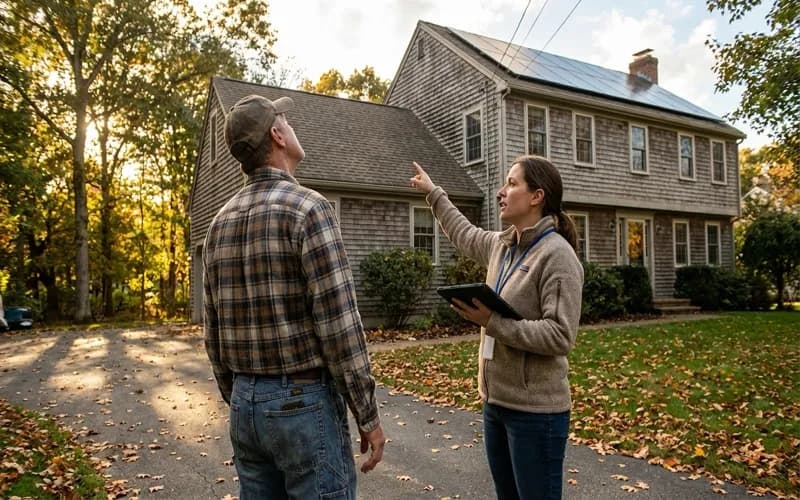
Find the Right Company for Your Home
Our free matching service connects New England homeowners with top-rated roof + solar companies. Get a no-pressure consultation with a company that serves your area.
Get Your Free ConsultationFree · No obligation · Serving MA, RI, CT, Southern NH & NJ
About the Author
Priya Shah
Consumer Finance Editor
Priya Shah covers personal finance and consumer advocacy with a focus on home energy decisions. She has analyzed solar financing structures, incentive programs, and loan products for New England homeowners since 2019. Priya helps readers understand the real numbers behind solar leases, PPAs, and purchase loans before they sign.
Related Guides
How Roof + Solar Bundles Work: A Complete Guide for New England Homeowners
A roof + solar bundle combines a full roof replacement with a solar panel installation into a single project, single contractor, and often a single financing agreement. Here's everything you need to know before your consultation.
What to Look For in a Roof + Solar Company: The Complete Evaluation Guide
A roof + solar bundle is a $40,000–$60,000 decision. The difference between the right company and the wrong one can mean decades of headaches — or decades of trouble-free savings. Here's exactly what to look for, and what questions to ask before you sign.
Ready to Get Started?
You've done your research. Now get matched with a top-rated New England roof + solar company for a free, no-obligation consultation.
Get Matched with a Top CompanyFree · Fast · No pressure · Serving MA, RI, CT, Southern NH & NJ