
Key Takeaways
- High-pressure sales tactics — especially "today only" pricing and door-to-door urgency — are the most common red flags in solar scams.
- Always verify a company's HIC registration, electrical licenses, and insurance before signing any contract.
- Legitimate companies will show you line-item pricing; refusal to break down costs is a major warning sign.
- If you've been scammed, file complaints with your state Attorney General, the FTC, and the BBB to create a public record.
Table of Contents▼
The Solar Scam Landscape
The residential solar industry is a legitimate and growing market with many reputable companies doing excellent work. But rapid industry growth has also attracted bad actors. The Federal Trade Commission, state attorneys general across New England, and the Better Business Bureau have all seen significant increases in solar-related consumer complaints over the past several years.
Solar scams take many forms. Some involve outright fraud — taking deposits and disappearing, or installing systems that don't work. Others are more subtle: misleading claims about savings, misrepresented incentive values, contracts with hidden fees or problematic terms buried in fine print, or aggressive sales tactics that pressure homeowners into decisions they'd never make with more time.
As someone who spent fifteen years in the roofing and construction industry before becoming a consumer advocate, I've seen both sides of this. Most contractors are honest professionals. But the combination of large transaction values (solar contracts often run $30,000–$60,000), long commitment periods (20–25 year lease and PPA agreements), and aggressive sales culture in some companies creates conditions where consumers need to be especially careful.
The good news: most scams have recognizable warning signs. This guide covers the red flags that should make you stop, slow down, and investigate before signing anything.
High-Pressure Sales Tactics: Stop and Walk Away
High-pressure sales tactics are the most common form of solar consumer harm — not fraud exactly, but practices designed to prevent you from making an informed decision. Learn to recognize them:
"This Offer Expires Tonight" or "Prices Go Up Tomorrow"
One of the most common and most effective high-pressure tactics is the artificial deadline. A salesperson tells you that the current price, rebate, or promotion expires at the end of their visit, tomorrow, or at the end of the month. The goal is to prevent you from comparison shopping or taking time to review the contract carefully.
Reality check: solar equipment prices don't change overnight. The federal ITC has been at 30% since 2022 and is legislated through at least 2032. State incentive programs have enrollment windows measured in months, not hours. When a salesperson creates urgency around a deadline that sounds like it expires in 24 hours, they are almost certainly manufacturing it.
The right response: "I need at least a week to review the contract and compare quotes. If you can't hold this price for a week, I'll have to look at other companies." A reputable company will hold the price. A high-pressure company that won't is telling you something important.
The "Government Program" or "Utility Rebate" Misrepresentation
Some solar salespeople represent their offering as a "government program" or imply that the federal tax credit is a rebate check you'll receive in the mail — rather than a credit against your income tax liability. This misrepresentation leads homeowners to overestimate their cash benefit and sign agreements based on incorrect financial assumptions.
The ITC is a tax credit. You must have federal income tax liability to claim it. If you pay little or no federal income tax (because your income is low, because you have other large deductions, or for other reasons), the credit may have limited value to you. A reputable company explains this clearly and asks about your tax situation. A deceptive company glosses over it or implies you'll get a check from the government.
Rushing the Contract Signing
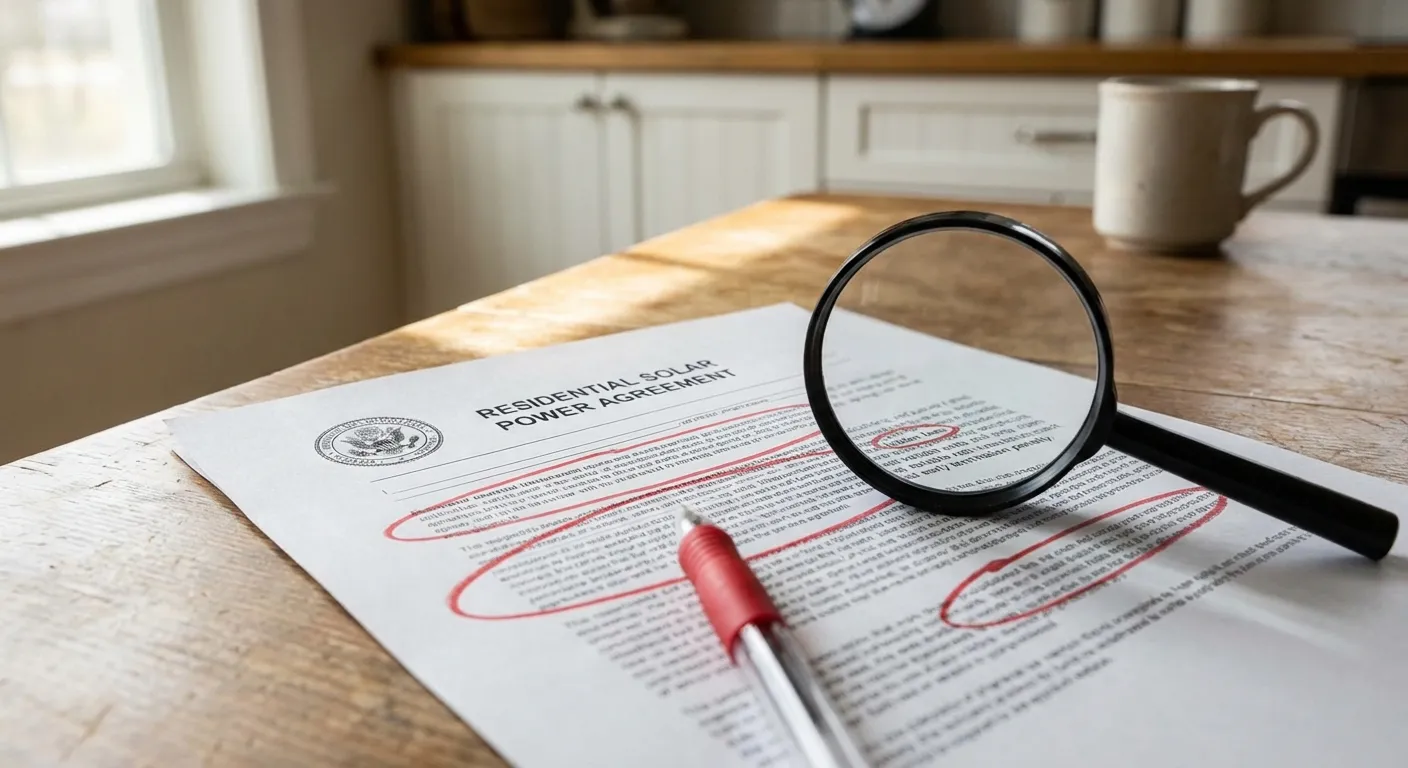
Be wary of any situation where a salesperson is eager to get you to sign that night, or where the contract appears at the kitchen table during the initial consultation with an expectation of an immediate signature. Solar contracts are legally binding, often 20+ pages long, and may contain provisions that are very difficult to exit.
You have the legal right to take the contract home and review it. You should. You should also have the right to have a family member, attorney, or financial advisor review it before you sign. Any company that objects to this is waving a significant red flag.
Unsolicited Door-to-Door Visits
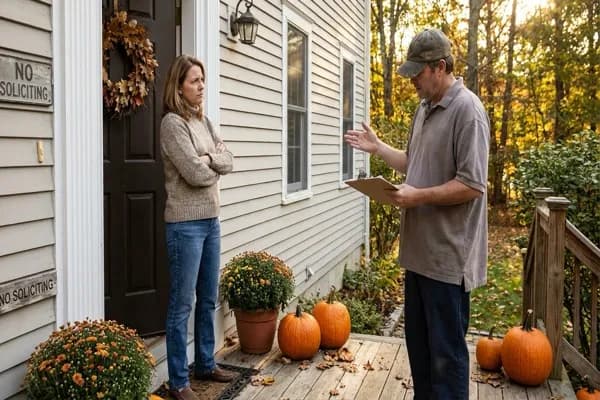
Door-to-door solar sales is a legal sales channel used by some legitimate companies. But it's also the channel through which much solar consumer fraud originates. Be especially cautious about:
- Salespeople who claim to be from your utility company (utility companies don't sell solar door to door)
- Solicitors who can't provide a business card with a verifiable company address and phone number
- Anyone who pushes for an immediate commitment during a door-to-door visit
- Claims that your "neighborhood has been selected" for a special program
Massachusetts, Rhode Island, and Connecticut all have Door-to-Door Sales regulations that give consumers the right to cancel a contract signed at their home within three business days. Know this right and use it if you ever feel pressured into signing before you're ready.
Misleading Claims and Misrepresentations
The "Free Solar" or "Free Roof" Promise
Our guide on whether you can really get a free roof with solar covers this in depth. The short version: there's no such thing as a truly free solar system or roof. When a company advertises "$0 out of pocket," they mean you can sign a lease or PPA agreement with no money down — but you're committing to 20+ years of monthly payments.
Legitimate $0-down solar financing exists and can be a good deal for the right customer. But it's not free. The misleading part is the implication that you're getting something for nothing, which obscures the long-term financial commitment you're making.
Inflated Savings Projections
Solar companies are required to provide production estimates, but the assumptions behind those estimates are where misleading practices hide. Watch for:
- Unrealistically high utility rate escalation assumptions: Projecting 5–8% annual utility rate increases makes the 20-year savings look spectacular. Historical New England utility rate increases have averaged 2–3%. A 5% assumption inflates projected savings by 30–40%.
- Ignoring system degradation: Solar panels degrade slightly each year — typically 0.5–0.7% per year, meaning your system produces about 12–15% less in year 25 than year 1. Some projections don't account for this.
- Assuming full consumption of production: If your system produces more electricity than you consume, you export the excess to the grid. Net metering credits are typically worth less than the retail rate you'd pay. Some projections assume all production is used at full retail value.
Misrepresenting Incentive Values
Incentive misrepresentation is common. We've seen companies:
- Present the ITC as a "rebate" that will arrive in the mail rather than a tax credit
- Quote state incentive values that are outdated or apply to different programs
- Fail to mention that the homeowner must have tax liability to benefit from the ITC
- Represent "potential" incentive values as guaranteed without noting eligibility requirements
Our incentives guide provides accurate current information. Use it as a reference to verify what you're being told.
Contract Red Flags
Solar contracts can be complex, and the problematic terms are often buried in the fine print. Here are the specific provisions to scrutinize:
Escalator Clauses in Leases and PPAs
Many solar lease and PPA agreements include an annual escalator — a provision that your monthly payment increases by a fixed percentage (often 2–3%) each year. A $150/month lease payment with a 3% annual escalator becomes $204/month by year 10 and $274/month by year 20. Depending on how utility rates actually move, this may or may not be favorable — but it must be disclosed and understood before signing.
Ask directly: "Does this agreement have an annual escalator?" and "What happens to my payment in year 10, year 15, and year 20?"
Transfer and Sale Provisions
If you sign a 20-year solar lease and then sell your home after 5 years, what happens? Typically, you have two options: transfer the lease to the new buyer, or buy out the remaining contract. Both have implications:
- Lease transfer requires the new buyer to qualify for and accept the existing agreement — not all buyers will
- Buyout amounts can be substantial, especially early in the lease term
The contract should specify clearly what happens at home sale. If it's vague, ask for a specific written answer before signing.
Roof Penetration and Damage Provisions
Solar installation involves penetrating your roof to mount panel racking. If the installation causes a roof leak or other damage, who is responsible? The contract should clearly assign liability. If it's ambiguous — especially if it seems to limit the company's liability for installation damage — that's a problem.
Performance Guarantees
Does the contract guarantee minimum production levels? If your system produces significantly less than projected — due to shading that wasn't accounted for, equipment underperformance, or other reasons — are you entitled to any remedy? Some contracts specify production guarantees; many don't. Know what you're getting.
Cancellation and Rescission Terms
You have a three-day right of rescission for contracts signed at your home under Massachusetts, Rhode Island, and Connecticut law. Read the contract's cancellation terms beyond the rescission window. If you change your mind after the rescission window closes but before installation begins, what are your options and costs?
Company Red Flags
Beyond specific tactics and contract terms, certain company characteristics should make you proceed with caution:
No Physical Address or Local Presence
Solar companies operating in New England should have a verifiable physical address — not just a PO box or a virtual office — and local staff who can be contacted. If a company's address doesn't resolve to a real location, or if it seems to have no local presence, be cautious about their commitment to service after the sale.
No Verifiable Reviews or Established History
Every company has some negative reviews. That's normal. What matters is the pattern: a company with hundreds of reviews averaging 4+ stars is different from a company with a handful of recent reviews and no history. Check Google, Yelp, the BBB, and state contractor license databases.
Be especially cautious with newly formed companies. Solar fraud often involves companies that form, collect deposits or sign agreements, perform poorly or disappear, and then re-form under a new name. A company with less than two or three years of verifiable operating history deserves extra scrutiny.
Unlicensed or Unverifiable Licensing Claims
Contractors doing roofing and electrical work in Massachusetts, Rhode Island, and Connecticut must hold appropriate state licenses. Ask for license numbers and verify them:
- Massachusetts: Check the Office of Consumer Affairs and Business Regulation (OCABR) for HIC registration; verify electrician licenses with the Board of State Examiners
- Rhode Island: Verify contractor registrations with the Contractors' Registration and Licensing Board
- Connecticut: Verify Home Improvement Contractor licenses with the Department of Consumer Protection
Subcontracting Everything Without Disclosure
There's nothing inherently wrong with subcontracting. But if a company presents itself as a self-performing installer and then hands your project off to unlicensed or unfamiliar subcontractors without your knowledge, that's a problem. Ask directly: "Do your own employees do the roofing and solar installation, or do you use subcontractors? If subcontractors, who are they and are they licensed?"
Vague or Absent Warranty Terms
A reputable bundle company can tell you specifically: what's the roof warranty (and with which manufacturer), what's the panel warranty (manufacturer product and performance), what's the inverter warranty, and what's the installation workmanship warranty. If warranty terms are vague, verbal, or absent from the contract, that's a serious red flag.
Savings Misrepresentation: The Math Behind the Claims
Solar savings projections are where the most sophisticated misrepresentation occurs, because the numbers are inherently complex and homeowners can't easily verify them in a sales meeting.
Request the Detailed Production Model
Ask the company for the detailed production model behind their savings projection. Reputable companies use software tools (PVWatts, Aurora, HelioScope) that provide transparent assumptions. The model should show:
- System size (kW) and expected annual production (kWh)
- Shading analysis based on your specific roof
- Utility rate assumption and escalation rate used
- System degradation rate assumption
- Financing costs (interest, term)
- Incentive assumptions (which programs, estimated values)
Check the Utility Rate Escalation Assumption
A 5% utility rate escalation assumption vs. a 2% assumption makes a dramatic difference in 25-year projections. Eversource has published historical rate data. Over the past decade, New England utility rates have increased at roughly 2–3% annually on average (with significant year-to-year volatility). Any projection using escalation rates above 4% deserves scrutiny.
Verify Your Utility Bills
The solar company will ask for your utility bills to size the system. The sizing should match your actual usage — not be oversized to increase the contract value. You can verify this: your utility bills show your monthly kWh consumption. The proposed system's annual production estimate should be comparable to your annual consumption (accounting for some over or underproduction depending on your goals).
How to Verify Before You Sign: A Checklist
Before signing any solar contract, run through this checklist:
- ☐ Verify the company's license numbers with your state licensing authority
- ☐ Check the BBB and Google reviews, reading 1-star reviews carefully to identify patterns
- ☐ Confirm physical office address — visit their location if possible, or at least verify it on Maps
- ☐ Ask who does the work — employees or subcontractors? Get subcontractor names if applicable
- ☐ Request the detailed production model in writing, including all assumptions
- ☐ Verify the utility rate escalation assumption — anything above 3.5% deserves justification
- ☐ Read the full contract before signing, or have an attorney review it
- ☐ Understand the lease escalator if applicable — calculate your payment in year 10 and year 20
- ☐ Understand what happens when you sell — how is the lease or PPA handled at home sale?
- ☐ Confirm warranty terms in writing — roof, panels, inverter, workmanship
- ☐ Get at least two other quotes — comparison reveals outliers immediately
- ☐ Don't sign that night — take at least a week, regardless of what pressure you feel
Our evaluation methodology is built around many of these same criteria. The companies we rate highly are those that pass this kind of scrutiny. Our company profiles include verified information about licensing, warranties, and customer satisfaction.
If You Suspect Fraud or Have Been Scammed
Use Your Three-Day Rescission Right
If you signed a contract at your home and have second thoughts, you have three business days to cancel under Massachusetts, Rhode Island, and Connecticut door-to-door sales laws. Send cancellation notice in writing via certified mail immediately — don't wait until day three.
Contact Your State Attorney General
- Massachusetts: Massachusetts Attorney General's Consumer Hotline: 617-727-8400
- Rhode Island: Rhode Island Attorney General Consumer Protection Unit: 401-274-4400
- Connecticut: Connecticut Department of Consumer Protection: 860-713-6300
File an FTC Complaint
The Federal Trade Commission accepts complaints about deceptive business practices at ReportFraud.ftc.gov. FTC complaints contribute to investigations that can result in enforcement action against patterns of fraud.
Contact the BBB
Filing a complaint with the Better Business Bureau creates a public record that helps other consumers and can prompt resolution from the company.
Consult an Attorney
If you've signed a problematic contract or been defrauded, an attorney specializing in consumer protection or construction law can advise you on your options. Many consumer protection attorneys work on contingency for fraud cases.
Start With a Company You Can Trust
Our matching process connects you only with companies that have passed our screening criteria — licensed, insured, with verified reviews and transparent contract terms.
Get Matched with Vetted Companies →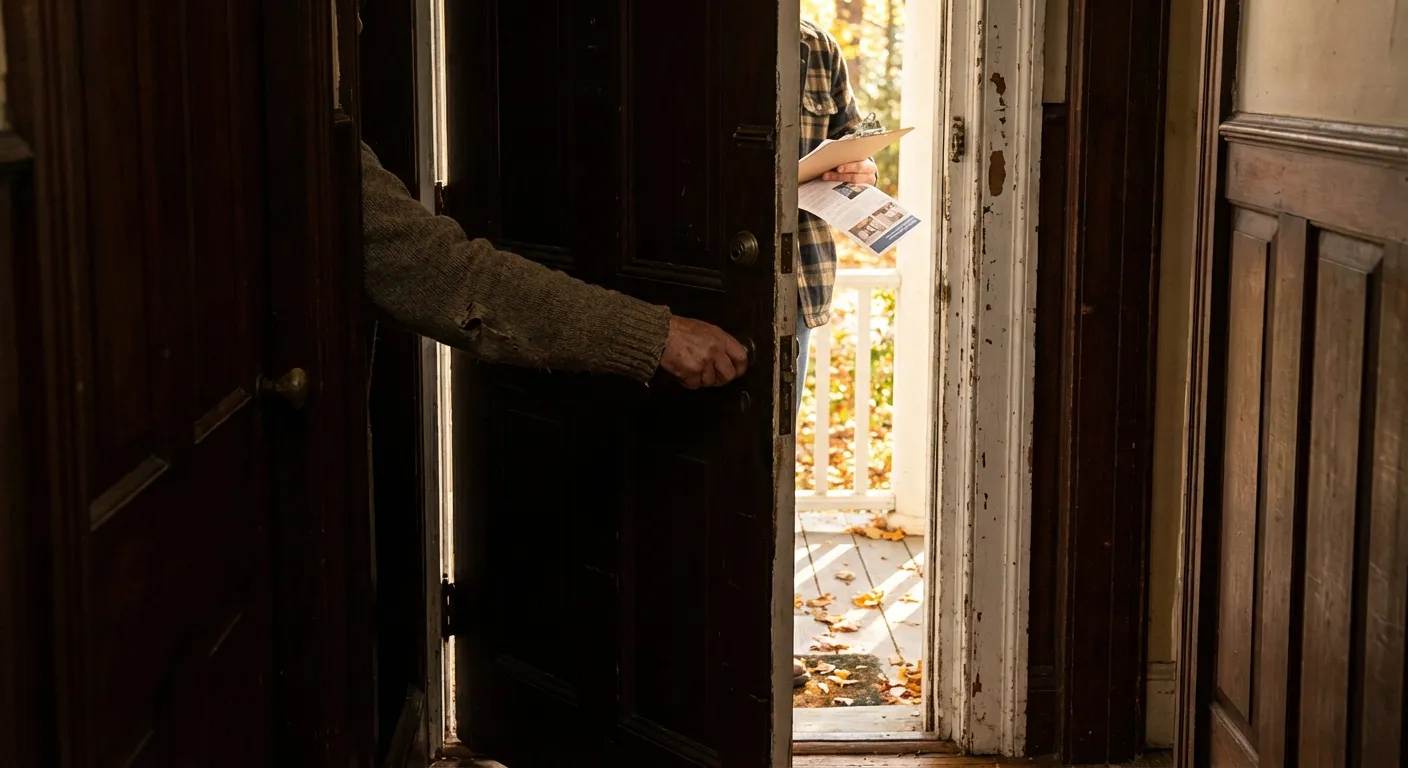
Find the Right Company for Your Home
Our free matching service connects New England homeowners with top-rated roof + solar companies. Get a no-pressure consultation with a company that serves your area.
Get Your Free ConsultationFree · No obligation · Serving MA, RI, CT, Southern NH & NJ
About the Author
Tom McAllister
Home Improvement Editor
Tom McAllister spent fifteen years in the roofing and construction industry before transitioning to consumer advocacy writing. Based in Providence, Rhode Island, he understands building codes, material warranties, and contractor red flags from the inside. Tom evaluates roof quality and installation standards for every company we review.
Related Guides
How Roof + Solar Bundles Work: A Complete Guide for New England Homeowners
A roof + solar bundle combines a full roof replacement with a solar panel installation into a single project, single contractor, and often a single financing agreement. Here's everything you need to know before your consultation.
What to Look For in a Roof + Solar Company: The Complete Evaluation Guide
A roof + solar bundle is a $40,000–$60,000 decision. The difference between the right company and the wrong one can mean decades of headaches — or decades of trouble-free savings. Here's exactly what to look for, and what questions to ask before you sign.
27 Questions to Ask a Roof + Solar Company Before You Sign
Most homeowners go into solar consultations without knowing what to ask. Companies know this — and some use the information asymmetry to their advantage. These 27 questions put you on equal footing with any sales team.
Ready to Get Started?
You've done your research. Now get matched with a top-rated New England roof + solar company for a free, no-obligation consultation.
Get Matched with a Top CompanyFree · Fast · No pressure · Serving MA, RI, CT, Southern NH & NJ